How to contact us

Landesentwicklungsgesellschaft Thüringen mbH (LEG Thüringen).

Mainzerhofstraße 12 | 99084 Erfurt
Phone: 0361 5603-0
Email

Industrial Production and Systems

The field of specialisation "Industrial Production and Systems" is a mainstay of the Thuringian economy. With growing markets and numerous activities in different sectors, this field contributes to about half of the turnover in Thuringia's manufacturing sector.

The Free State has a strong entrepreneurial base in the fields of manufacturing technology, the plastics processing industry, mechanical engineering and toolmaking, measurement and control technology, micro and nanotechnology, optics/photonics, sensor technology and robotics, as well as materials and material systems.

The scientific expertise of the seven Thuringian universities and 15 research facilities is particularly strong. It is closely interlinked with the Thuringian economy and is being increasingly expanded – currently through two growth cores, one WIR! and three RUBIN consortia in the implementation phase. Three other RUBIN projects have been positively approved and are in the concept phase.

The economy in the field of specialisation in figures

14.8 Turnover in billion euros
3300 Companies
100000 Employees subject to social security contributions

Data source: own calculation based on TLS data, as of 2020 (figures rounded)

Profile

The factory of the future will be more flexible, more efficient, faster and more sustainable. The adaptability of manufacturing processes in particular will be a decisive factor for future competitiveness. If they become flexibly configurable, small local sites with correspondingly in-depth manufacturing know-how are possible. Increasing digitalisation will allow processes to be linked even more strongly, even across factories, and thus optimise supply chains. Many local and smart value creation networks will emerge. Through sensor technology, analytics and artificial intelligence, productivity is increased and downtimes and maintenance are reduced.

The digitalisation of production and the systemic networking of value chains into value networks in the sense of "Industry 4.0" is of central importance for Thuringia as a location for innovation. The production world of tomorrow will be accompanied by an increasing linking of the real and the digital world. On the one hand, intelligent information, communication and management systems can be used to link internal company processes and resources more closely, and on the other hand, complete value chains are networked from the supplier to other producers and all the way to the customer. New automation solutions, intelligent robotics and autonomous systems will support skilled workers specifically in routine work. Nevertheless, humans also widely play the central role: Safe and ergonomic human-machine interaction results in skilled workers being able to concentrate on their core competencies. The image of a factory floor will change into an interactive, digitalised place, not least due to the European "Green Deal".
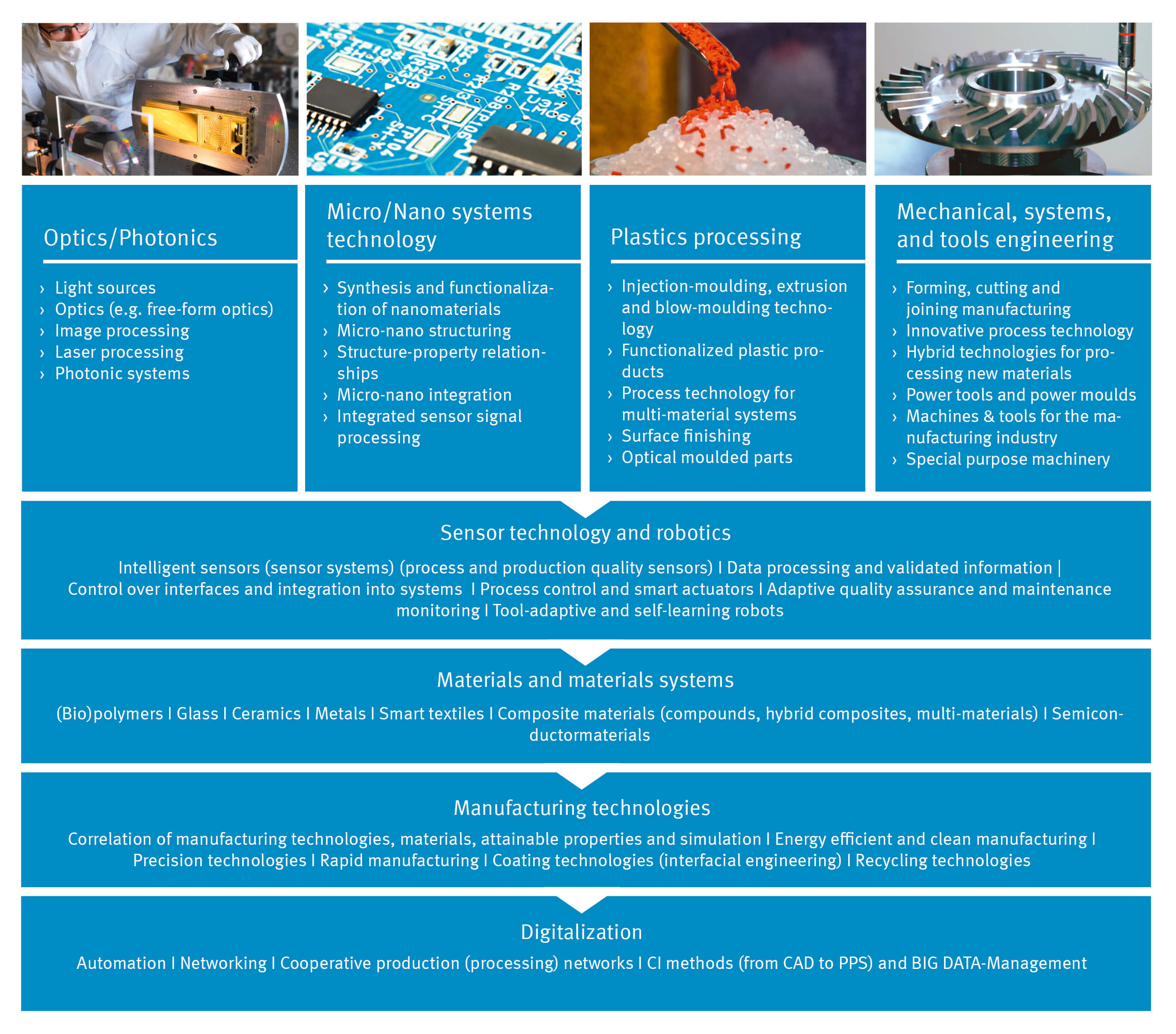
That is why we are driving the following issues forward sustainably in a four-pronged approach:

  • Assistance systems for safe and ergonomic human-machine interaction
  • Functional integration for innovative products
  • Photonics and sensor technology for the world of tomorrow
  • Smart manufacturing systems for efficient, flexible and precise production


Fast reactions are crucial for us – both to changes in the market and to technological developments. That is why we ensure that the existing Thuringian competencies in the various technology segments are optimally utilised, continuously expanded and efficiently interlinked. Thuringia is well-prepared for the path into the digitally networked future thanks to its innovative companies, its deep research and education landscape, its excellent R&D expertise and its strong networks and cluster structures.

Vision and goals

Thuringia is a high-tech and internationally visible production region. Their success is based above all on interdisciplinarity, competitive infrastructure, rapid market response and innovative strength. In addition, there are other central guiding principles:

  • In Thuringia, we make use of the opportunities arising from technical progress, demographic change, scarcity of resources and increasing globalisation.
  • We are systematically expanding growing markets, existing lighthouses and top positions in optics/photonics, plastics processing, manufacturing technology, measurement and sensor technology and in the use of innovative material systems, thereby providing radiance for further interdisciplinarity.
  • Thuringian companies are developing into system suppliers and generating innovations by intelligently linking subject areas.
  • Thuringian companies are strengthening and expanding their position in the world market through progressive internationalisation.
  • Manufacturing companies increase their system competence in a targeted manner and thus strengthen their international competitiveness.
  • Product development times are significantly reduced, while at the same time market and customer proximity are sustainably increased.
  • Special machinery and tooling companies strive for technology leadership through smarter and more powerful system solutions and product complementary services.
  • The creative industries provide impulses for interdisciplinary cooperation in innovation processes and the development of user-oriented products.

Reference

Your contact persons

Reference

Kay Sawatzky

Kay Sawatzky Field of specialisation – Industrial production and systems

Alexander Dieser

Alexander Dieser Field of specialisation – Industrial production and systems

[linguise]